Eduqas · GCSE · English Language
Scope of study
This study guide covers the essential reading and writing skills required for WJEC Eduqas GCSE English Language. It focuses on identifying information, analysing language and structure, comparing viewpoints, and producing effective creative and transactional writing.
- 6 min read
- 3 worked examples
- 5 practice questions
- 8 key terms
Study Notes
Overview
GCSE English Language is fundamentally a skills-based qualification. Unlike Literature, you are not assessed on your knowledge of set texts, but rather on your ability to read, interpret, and analyse unseen texts, and your ability to write clearly and effectively for different purposes. The WJEC Eduqas specification tests these skills across two exam components and one spoken language endorsement. Component 1 focuses on reading fiction and writing creatively, while Component 2 focuses on reading non-fiction and writing transactionally.
Listen to our revision podcast for an overview of the core concepts and exam tips:
Reading Skills
Identifying Information & Ideas (AO1)
Assessment Objective 1 requires you to locate and interpret both explicit and implicit information from unseen texts. Explicit information is directly stated, while implicit information requires you to 'read between the lines' to understand what is being suggested. When asked to 'identify' or 'list', keep your answers brief and focused. Always ensure you are drawing your evidence directly from the specified lines in the text.
Analysing Language (AO2)
This is where many candidates lose marks by merely 'feature-spotting'. Identifying a technique is only the first step; the marks are awarded for explaining the effect of that technique on the reader.
Key Language Features to Identify
| Feature | Definition | Effect on Reader | Example |
|---|---|---|---|
| Metaphor | Describing something as if it is something else. | Creates vivid imagery and helps the reader understand complex ideas through comparison. | "The city was a beast, waiting to strike." |
| Simile | Comparing two things using 'like' or 'as'. | Makes descriptions more relatable and visual. | "The wind howled like a wounded animal." |
| Personification | Giving human qualities to non-human things. | Brings objects or nature to life, often reflecting the mood of the scene. | "The trees danced in the wind." |
| Pathetic Fallacy | Giving human emotions to the weather or environment. | Sets the atmosphere or reflects a character's internal state. | "The dark clouds wept heavily over the funeral." |
| Alliteration | Repetition of the same consonant sound at the start of words. | Draws attention to a phrase, creating rhythm or emphasizing a mood. | "The sinister, slithering snake." |
| Sibilance | Repetition of 's' sounds. | Can create a soft, soothing effect or a harsh, hissing, sinister tone. | "The silent shadows stretched across the sand." |
| Juxtaposition | Placing two contrasting ideas or images close together. | Highlights differences and creates tension or dramatic effect. | "A bright flower blooming in the ruined wasteland." |
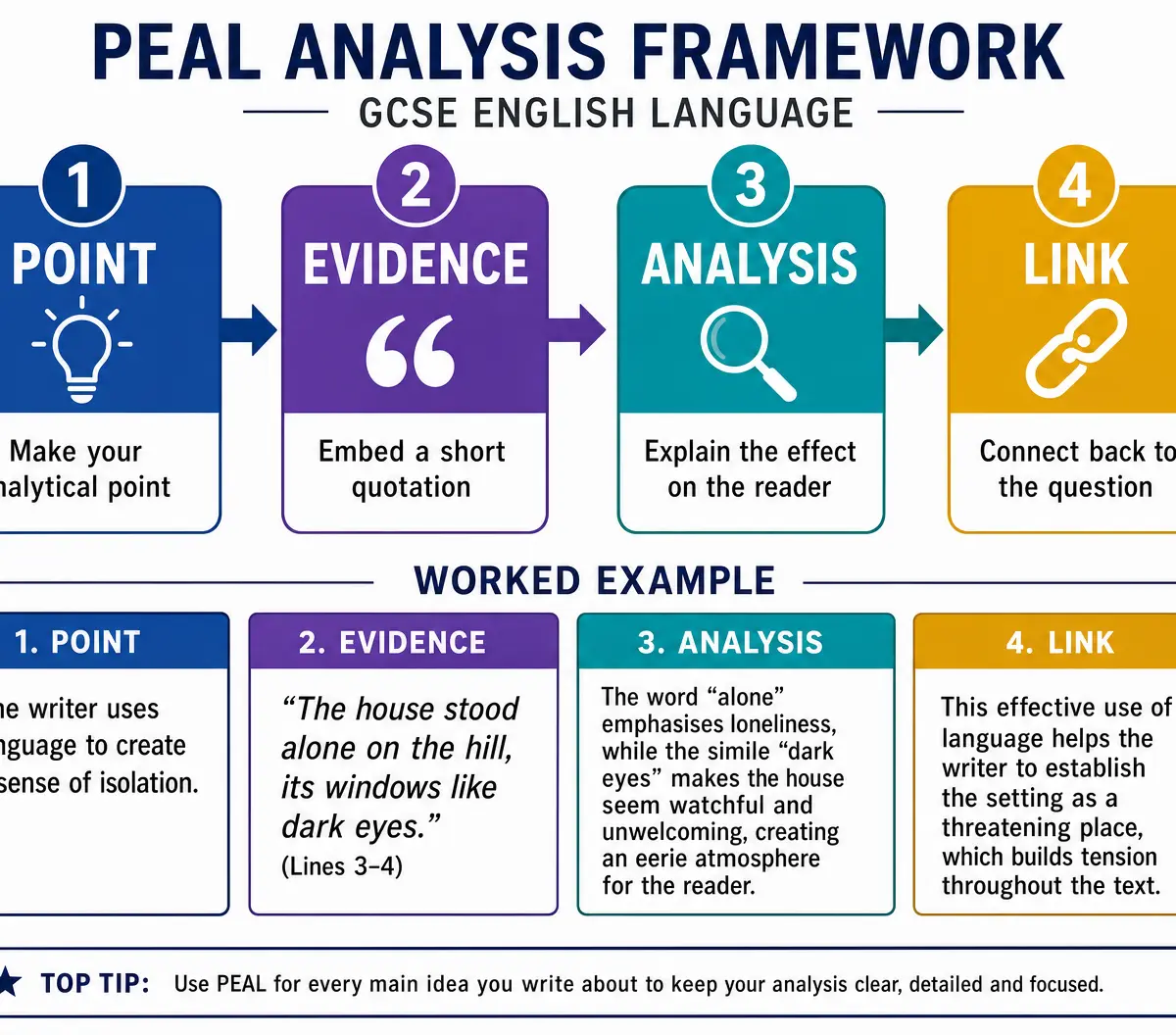
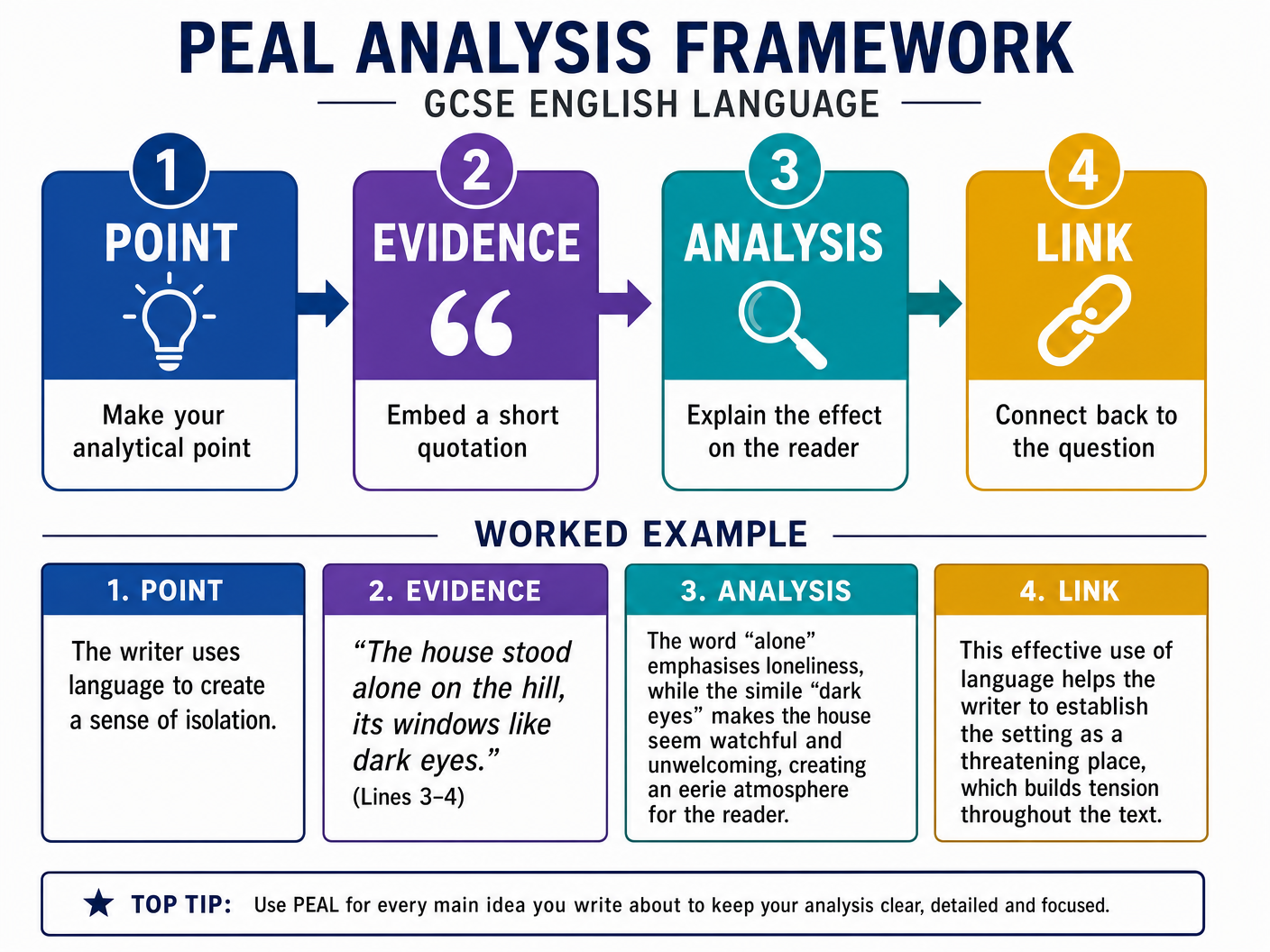
When writing your analysis, use the PEAL framework to ensure you cover all necessary steps:
Analysing Structure (AO2)
Structural analysis focuses on how the text is put together, rather than the specific words used. You should consider:
- Openings and Endings: How does the writer hook the reader? Is there a satisfying or cliffhanger ending?
- Shifts in Focus: Does the writer move from the general to the specific, or from the outside to the inside?
- Narrative Perspective: Is it first-person (intimate, biased) or third-person (observational, omniscient)?
- Sentence Length: Short sentences can create tension or speed up the pace; long, complex sentences can slow the pace or provide detailed description.
- Paragraphing: Are paragraphs used to isolate important ideas or show the passage of time?
- Cyclical Structure: Does the ending return to an idea from the beginning?
- Foreshadowing: Are there hints about what will happen later?
Evaluating Critically (AO4)
Evaluation requires you to form a judgement about a text and support it with evidence. You will often be given a statement (e.g., "A student said: 'The writer makes the ending very tense.' To what extent do you agree?").
The best approach is to agree 'to some extent' or 'mostly agree', allowing you to explore both sides of the argument. Your structure should be: Statement → Evidence → Analysis of methods used → Link to the evaluation.
Comparing Writers' Viewpoints (AO3)
In Component 2, you must compare how two different writers convey their ideas and perspectives. A successful comparison requires a structured approach. You must identify the viewpoints, compare the methods used to convey them, and evaluate their effectiveness. Always use comparative connectives (e.g., 'Similarly', 'In contrast', 'Whereas').
Writing Skills
Creative Writing (AO5 & AO6)
Component 1 requires you to write a narrative or descriptive piece. The key to success is planning. A well-planned, structured response will always score higher than a rambling, unstructured one.
- Show, Don't Tell: Instead of saying "He was angry", describe his clenched fists and red face.
- Sensory Description: Use sight, sound, smell, touch, and taste to create an immersive environment.
- Varied Sentences: Mix short, punchy sentences for impact with longer, descriptive sentences for detail.
- The One-Scene Rule: Focus on a single, well-developed scene rather than trying to tell an epic, sprawling story in 45 minutes.
Transactional/Non-Fiction Writing (AO5 & AO6)
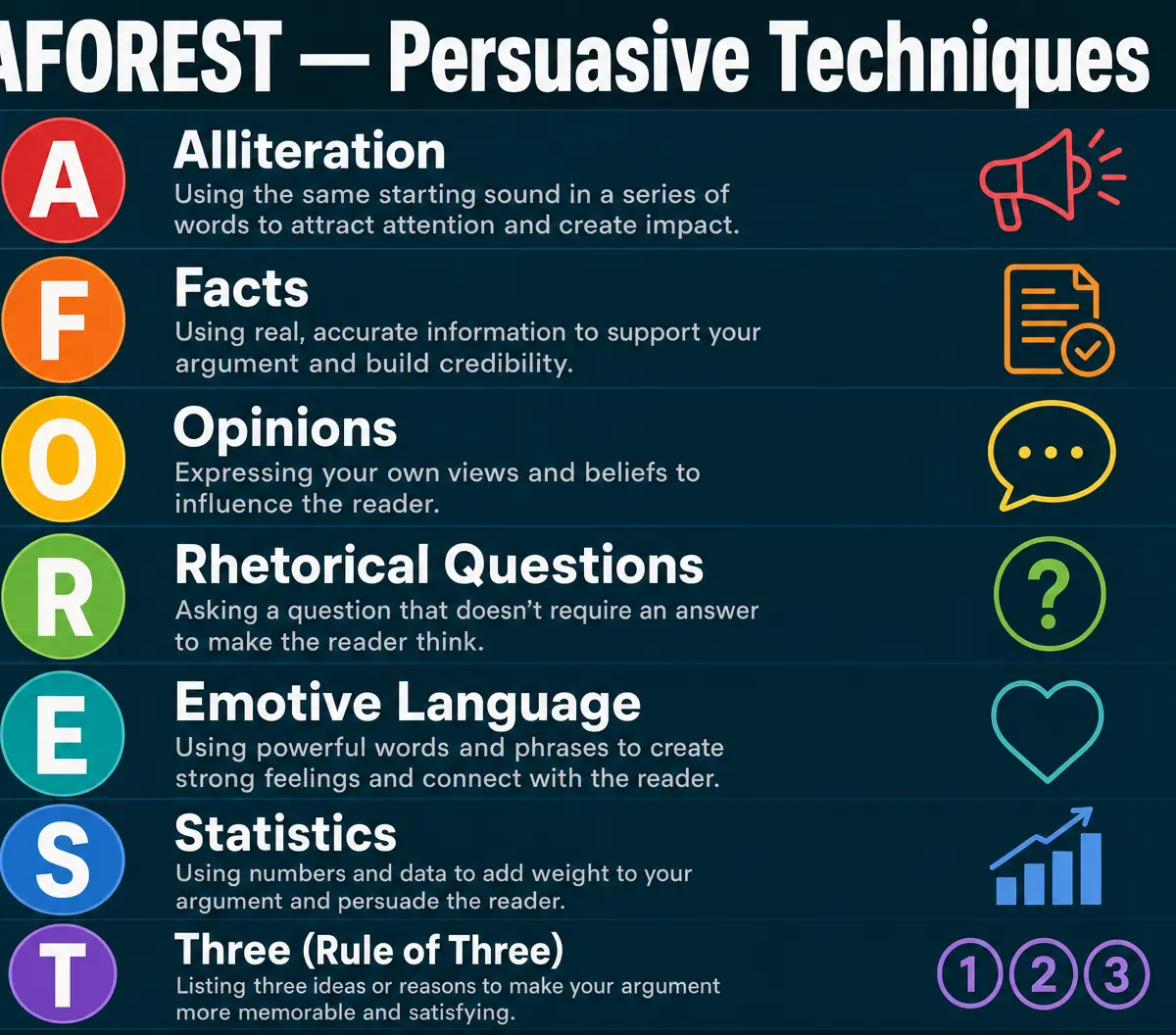
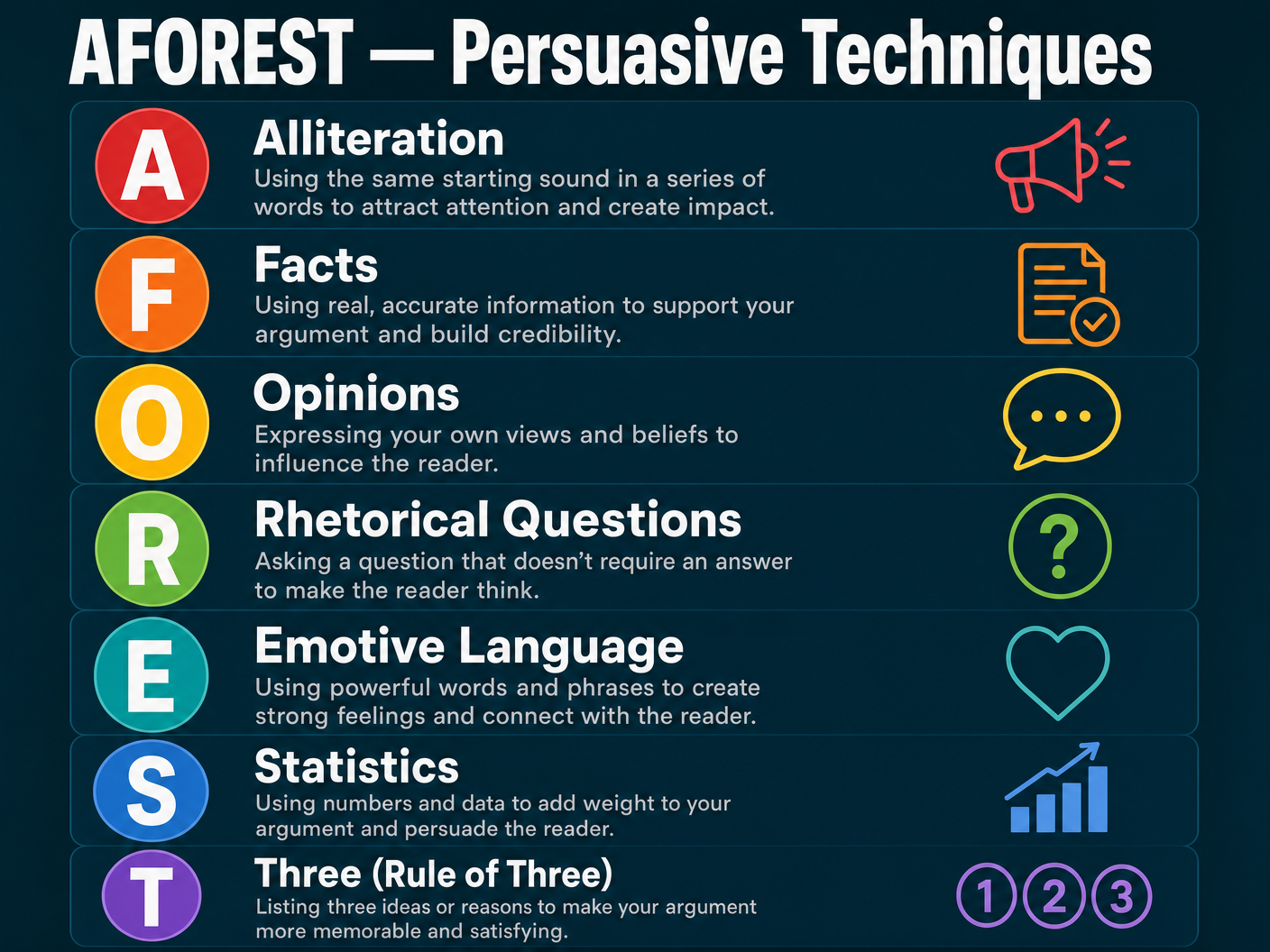
Component 2 requires writing for a specific purpose and audience (e.g., an article, a formal letter, a speech). You must adapt your tone, style, and register accordingly. If you are writing a persuasive piece, use the AFOREST techniques:
Technical Accuracy (SPaG)
Spelling, punctuation, and grammar (SPaG) account for a significant portion of your writing marks.
- Use ambitious vocabulary, but ensure you know what the words mean.
- Demonstrate a range of punctuation: use commas accurately, but also try to include semicolons, colons, or dashes for effect.
- Ensure your paragraphs are cohesive, using discourse markers (e.g., 'Furthermore', 'Consequently', 'However') to link your ideas logically.
Visual Resources
2 diagrams and illustrations
Interactive Diagrams
2 interactive diagrams to visualise key concepts
Conceptual Flow Outline
English Language Exam Approach Flowchart
Conceptual Flow Outline
Comparison Framework for AO3
Worked Examples
3 worked examples — open one to explore the question and available guidance.
Practice Questions
Test your understanding — click to reveal model answers
List four things we learn about the house from lines 1-5. [4 marks]
Hint: This is an AO1 question. Keep your answers brief and ensure they are drawn only from the specified lines.
How does the writer use language to describe the weather? [8 marks]
Hint: Use the PEAL structure. Identify techniques, embed short quotes, and explain the effect on the reader.
Compare how the two writers convey their different attitudes towards technology. [14 marks]
Hint: Identify the attitude in Text 1, then Text 2. Use comparative connectives to highlight the differences, and analyse the methods they use to show these attitudes.
Write a description suggested by this picture: [An image of a busy market]. [24 marks]
Hint: Plan your structure. Use sensory details and 'show, don't tell'.
A student said: 'The writer successfully builds tension throughout the extract.' To what extent do you agree? [10 marks]
Hint: Form a judgement, select evidence, and analyse how the writer's methods (language and structure) build that tension.